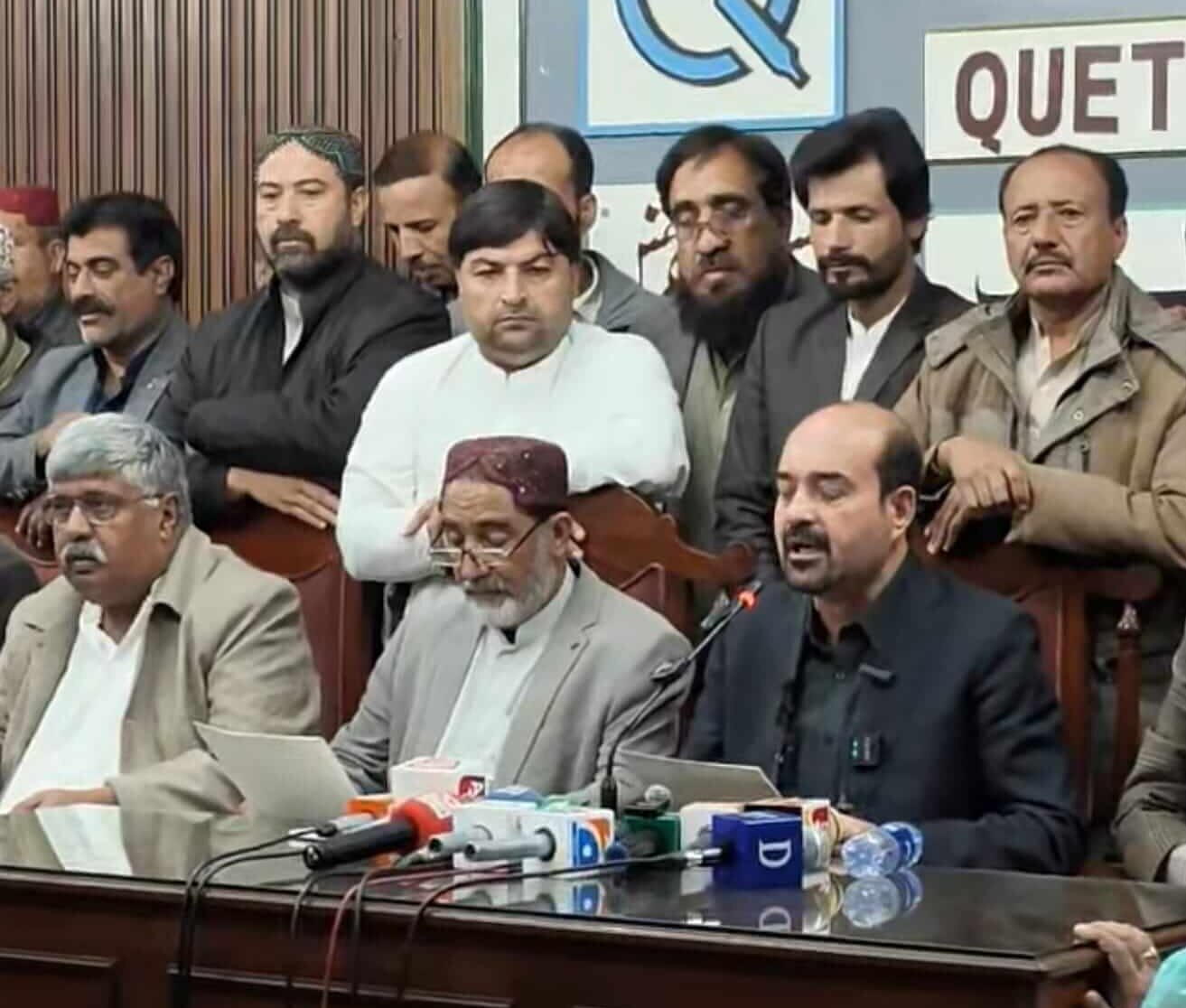
Syed Ali Shah: An all-parties representative delegation on Tuesday announced the suspension of protests across Balochistan following constructive talks with a government committee. The decision was taken as a goodwill gesture in view of the prevailing situation in the province, while the Balochistan government agreed to release all employees arrested during the demonstrations.
The breakthrough came during a meeting between government representatives and leaders from several political parties, including the Awami National Party (ANP), National Party, Pakhtunkhwa National Awami Party (PkNAP), Pakistan Tehreek-e-Insaf (PTI), and other stakeholders.
The all-parties delegation was led by ANP provincial president Asghar Khan Achakzai and included National Party central vice president Dr Ishaq Baloch, PkNAP provincial president Nasrullah Khan Ziaray, PTI leader Salam Agha, HDP’s Ismat Yari, ANP leader Sanaullah Kakar, National Party’s Mir Inayat Buzdar, employees’ representative Ismail Kasi, and NDM leader Inayat Shah.
On behalf of the Balochistan government, members of the authorized committee included Provincial Minister for Finance and Minerals Mir Shoaib Nosherwani, Provincial Education Minister Rahila Hameed Durrani, Provincial Minister Ali Madad Jatak, PPP leader Syed Iqbal Shah, Principal Secretary to the Chief Minister Imran Zarkoon, and Special Secretary Finance Arif Khan Achakzai.
During the talks, the all-parties delegation formally announced the end of province-wide protests, citing the need for unity and stability in Balochistan. In return, the government committed to releasing all detained employees, a move welcomed by political leaders and employee representatives alike.
Both sides agreed to continue the dialogue, with a follow-up meeting scheduled for February 12. The upcoming session will bring together senior political leaders and the government committee to develop a clear roadmap for addressing all outstanding and long-standing issues. Observers see the development as a significant step toward restoring trust, reducing tensions, and promoting political consensus in Balochistan.