Syed Muhammad Waseem:
AI is changing the way we create and collaborate, with 41% 1 of brands already using it for video production. Production teams now have to create more content faster than ever. Staying on track while keeping ideas fresh is a daily challenge. AI is changing how production teams plan, shoot, and edit. It’s making the process faster, smarter, and more creative.
As the need for faster content grows, AI is becoming a key tool in modern studios. It helps creators stay up to date with new trends and what audiences want. Studios are using AI to work faster and save money. According to Deloitte’s2 2024 report, 42% of executives say it boosts efficiency and productivity.
Let’s explore how AI is changing production from planning to editing. You’ll learn how it saves time, cuts costs, and boosts creativity. By the end, you’ll see how it’s making modern production smarter and faster.
The Evolution of AI in Media Production
AI in media production has evolved rapidly over the years. Initially, it served as a basic tool for handling repetitive tasks such as video editing, adding visual effects, and creating computer graphics. Over time, it has transformed into a powerful creative partner that now supports teams at every stage of production.
In the beginning, AI was mainly used for CGI, video automation, and voice synthesis. These tools helped save time but still required significant human input. Today, AI plays an active role across pre-production, production, and post-production, making the entire process more efficient and consistent.
During pre-production, it assists with scriptwriting, budgeting, and storyboarding. In production, it enhances camera tracking, lighting adjustments, and virtual set design. Finally, in post-production, it streamlines editing, color correction, sound design, and even creates advanced visual effects.
Major studios such as Netflix and Warner Bros. are now using AI-driven tools to analyze audience preferences, optimize workflows, and enhance storytelling. As a result, AI has shifted from being a simple technical assistant to becoming an essential force shaping the future of modern media production.
Why Production Houses Are Turning to AI
Production houses are facing rising costs and tighter schedules. Keeping up with deadlines while staying creative has become a major challenge. To stay efficient, many studios are now using AI to manage time and60% of post-production studios utilize AI-powered editing tools to reduce editing time. reduce expenses. This trend is growing rapidly as the global AI in media and entertainment market is projected to reach $34.1 billion3 by 2027.
The demand for quick content is also increasing. Streaming platforms compete to release new shows faster, putting pressure on production teams. At the same time, 65% of advertising agencies are already using AI tools for content creation, showing how quickly the industry is adapting to new technology.
There is also a shortage of skilled post-production professionals. AI tools step in to handle repetitive work like cutting scenes or syncing dialogue. This gives creative teams more time to focus on storytelling and innovation while keeping projects on schedule and within budget.
How Production Houses Are Using AI
AI is changing how production houses work from start to finish. It supports every stage of filmmaking, from planning and shooting to editing and final delivery.
In Pre-Production
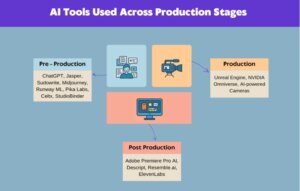
AI is making the pre-production stage faster and more creative. Writers now use tools like ChatGPT, Jasper, and Sudowrite to draft scripts or explore story ideas. In fact, 60% of film studios are exploring AI-driven scriptwriting tools to speed up brainstorming and script development. These tools help generate dialogue, plot twists, and creative concepts in minutes, saving time while keeping creativity flowing.
Storyboarding and concept visualization have also become easier. Tools like Midjourney, Runway ML, and Pika Labs turn written ideas into visuals, helping directors and producers see how scenes might look before filming begins. This makes planning smoother and reduces the need for costly revisions later.
AI is also improving casting and budgeting. Some tools analyze data to predict how well an actor will connect with audiences. AI software like Celtx and StudioBinder helps plan budgets and schedules. These tools make it easier for studios to manage costs, track spending, and stay on time.
In Production
AI is transforming the way films are shot on set. For example, AI-powered cameras can automatically track actors, adjust framing, and optimize lighting in real time. This helps directors capture perfect shots faster and reduces the need for repeated takes. According to MarketsandMarkets4, the use of AI cameras in film production is expected to grow by 22% annually by 2027.
Virtual production is becoming more common. Tools like Unreal Engine and NVIDIA Omniverse allow filmmakers to create realistic digital environments before filming begins. These virtual sets save time, cut costs, and give teams more creative freedom, especially for large-scale or fantasy projects.
AI supports crews during filming. Voice recognition systems can follow script lines or adjust camera settings through simple voice commands. As a result, on-set work becomes smoother, and the crew can focus more on storytelling rather than technical details.
In Post-Production
This phase gets a big boost from AI, especially in editing and sound design. Tools like Runway ML, Adobe Premiere Pro AI, and Descript automate tasks like cutting, syncing, and scene detection. Smart apps can identify key moments and streamline workflows, helping editors focus on storytelling.
AI also improves color grading and sound editing. It can automatically balance colors, refine lighting, remove background noise, and sync soundtracks. Even some free tools can apply complex color grading for a consistent look. These features save time and make the final product polished and professional.
In addition, AI enhances VFX, CGI, and localization. It removes green screens, fills missing frames, and generates realistic effects quickly. Voice tools like Resemble.ai and ElevenLabs speed up dubbing and translations for multiple languages. The use of AI in video editing has reduced production time by an average of 30%, showing how much it improves efficiency.
AI also helps with versioning and distribution. It can create multiple edits for different platforms like social media, TV, or YouTube Shorts. This allows studios to repurpose content easily and deliver it quickly. Overall, AI makes post-production faster, more precise, and more creative.
Case Studies: How AI Is Shaping Modern Production
Case Study 1: Netflix Builds a Cloud-Based VFX Studio
Netflix, one of the biggest entertainment companies in the world, began producing its own content in 2012. To make collaboration easier, the company wanted to create a visual effects (VFX) studio in the cloud. This would let artists from different countries work together without being limited by location.
Using NICE DCV and Amazon EC2 G4 instances, Netflix built fast and secure remote workstations. These cloud tools allowed artists to edit, animate, and render with high-quality visuals while keeping performance smooth. The system helped Netflix move from testing to full production in just one year.
By using AWS, Netflix reduced costs and technical barriers for creators. The company could now attract top VFX and animation talent from anywhere in the world. This innovation showed how cloud and AI tools can transform modern film production.
Case Study 2: Cropify’s AI Innovation in Grain Grading
In South Australia, Anna Falkiner and Andrew Hannon founded Cropify to make grain testing faster and more accurate. Traditional testing relied on human inspection, which often caused mistakes and disagreements. The founders wanted a smarter AI-based way to grade crops.
Working with the Australian Institute for Machine Learning (AIML), they built AI software that could analyze grain samples in seconds. Their system reduced testing time from 24 minutes to just 90 seconds and achieved 98% accuracy. This made the grain supply chain faster and more reliable.
In 2024, Cropify raised $2 million AUD from investors to expand its technology. Their success proved that AI can bring real value to agriculture by making testing fairer, faster, and more consistent. Falkiner advises businesses to focus on real problems first and then see if AI is the right solution.
Case Study 3: What’s Next Entertainment’s Use of AI in Creative Production
What’s Next Entertainment is redefining how film production teams approach creativity and pre-production. To make their workflow smoother and boost creative output, the company uses AI tools like Midjourney and ChatGPT in its daily process.
During the early stages of filmmaking, the team uses Midjourney for storyboarding and visual exploration. It helps them create detailed visual references, test color palettes, and shape the overall look and feel of each scene before production begins. This saves time and improves collaboration among directors, designers, and cinematographers.
Meanwhile, ChatGPT supports ideation and research. The team uses it to study brands, conduct competitive analysis, and refine their sentence structures and ideas for better storytelling.
Case Study 4: The Late Show with Stephen Colbert Uses Runway ML
The production team behind The Late Show with Stephen Colbert adopted Runway ML, an AI video tool, to speed up editing. Before using AI, editing a single segment could take five hours. With Runway, the same job now takes five minutes.
The team uses Runway to create visuals, edit green-screen shots, and animate characters. They can even sync voice lines automatically to match a person’s mouth movements. This helps them produce high-quality content much faster.
Although they don’t rely entirely on AI, Runway saves the team hours of manual work. It allows them to focus more on creativity and storytelling. This case shows how AI tools can make TV production quicker, easier, and more innovative.
Benefits of AI Adoption
- Faster and more affordable production:
AI streamlines time-consuming tasks like editing, scheduling, and rendering. This helps studios finish projects quicker while saving on labor and production costs. - More room for creativity:
With AI handling routine work, creators can focus more on storytelling and artistic direction. It encourages experimentation with new styles, visuals, and concepts. - Equal opportunities for all:
Small studios can now access advanced tools that were once limited to big productions. This levels the playing field and promotes more diverse creative output across the industry. - Better post-production quality:
AI improves color correction, sound design, and effects with precision and consistency. It reduces human error and enhances the overall quality of the final product. - Consistent and quick results:
Automated tools ensure every version of a project maintains the same high standard. Revisions and updates can be made instantly, keeping workflows smooth and efficient.
The Future of AI in Production Houses
The future of AI in production houses looks promising. Studios are moving toward hybrid workflows where humans and AI work together. This collaboration helps balance creativity with efficiency. AI tools will keep improving, assisting in editing, directing, and visual design while creators focus on storytelling and emotional depth.
In the coming years, AI will personalize media based on audience preferences. It will also play a key role in virtual and augmented reality experiences. As these technologies grow, new skills like AI editing and prompt engineering will become essential. Most importantly, AI will act as a co-creator, not a replacement, helping filmmakers bring ideas to life faster and smarter.
Frequently Asked Questions
Will AI replace human jobs in film production?
No, AI won’t replace humans but will support them by automating repetitive tasks and allowing creators to focus more on storytelling and creativity.
Does Netflix use AI in film production?
Yes, Netflix uses AI for tasks like content recommendations, script analysis, and optimizing production workflows.
How is AI improving film editing?
AI speeds up editing by automatically detecting scenes, enhancing visuals, and reducing production time by up to 30%.
Conclusion
AI is changing every part of film production, from writing scripts to final editing. It makes the process faster, more accurate, and cost-effective. Each phase, from pre-production to post-production, is becoming smoother with AI tools helping teams work smarter and save time.
Still, human creativity remains the heart of filmmaking. AI supports imagination but cannot replace emotion or storytelling. As production houses embrace AI, the boundary between technology and creativity is fading and the result is a new era of storytelling.