Editorial:
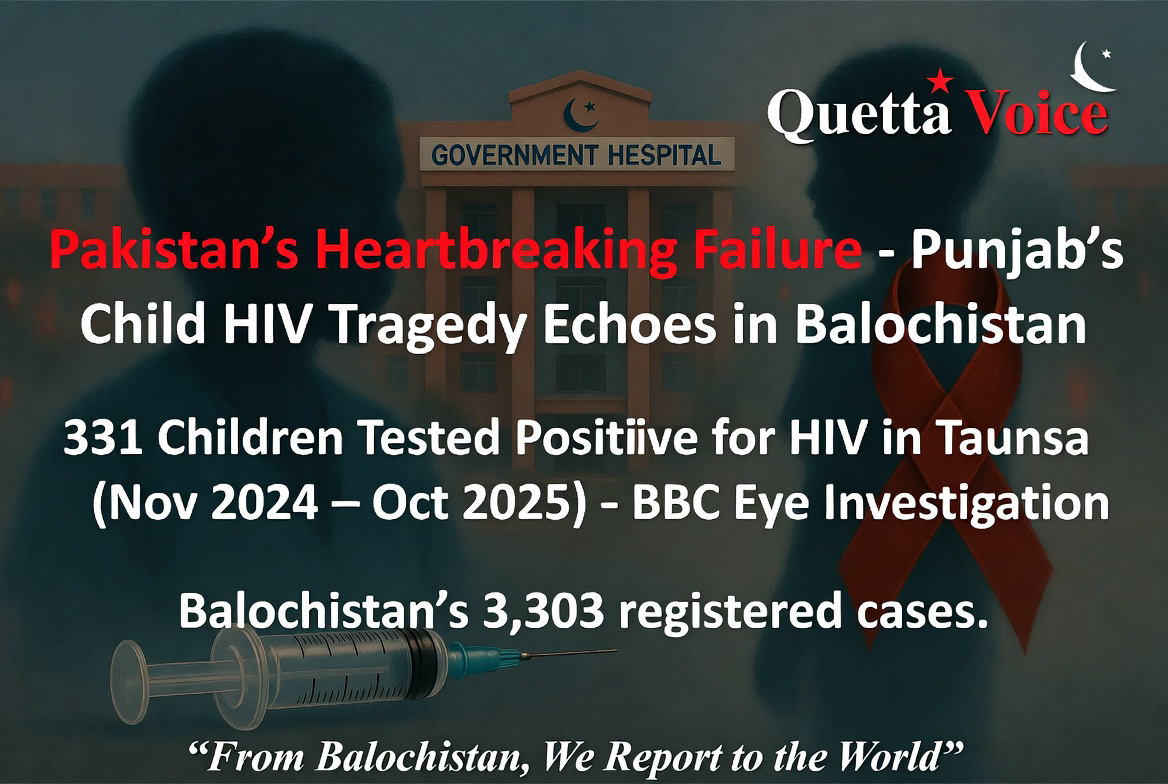
In the quiet town of Taunsa, Punjab, a silent horror has claimed the innocence of hundreds of children. Between November 2024 and October 2025, 331 children tested positive for HIV — a shocking figure that lays bare the deep cracks in Pakistan’s public healthcare system.
Eight-year-old Mohammed Amin was one of them. His high fevers were so unbearable that he begged his mother to let him sleep in the pouring rain for relief. “It felt like he had been thrown into boiling oil,” Sughra recalled, her voice breaking with grief. He passed away shortly after his diagnosis. At his graveside, his 10-year-old sister Asma knelt quietly and whispered, “He used to fight with me, but he also loved me.” Tragically, soon after her brother’s illness, Asma too was diagnosed with HIV.
The family firmly believes both children contracted the virus through contaminated needles during routine treatment at the government-run THQ Taunsa hospital.
The outbreak first surfaced when a private clinic doctor noticed the alarming spike in cases in late 2024. Authorities promised swift action and suspended the hospital’s medical superintendent in March 2025. Yet a BBC Eye investigation revealed that unsafe practices continued. In 32 hours of undercover filming in late 2025, reporters documented syringes being reused on multi-dose medicine vials on 10 separate occasions. In four of those cases, the same vial was used for different children.
Dr Altaf Ahmed, a respected consultant microbiologist and infectious disease expert, reviewed the footage and warned: “Even attaching a new needle does not eliminate the danger. The syringe body itself can carry the virus.”
This tragedy is not confined to Punjab. Pakistan as a whole is grappling with a growing HIV crisis, with over 84,000 registered cases nationwide and estimates suggesting the true figure could be much higher.
Here in Balochistan, the situation remains deeply concerning. As of December 2025, the province has recorded 3,303 registered AIDS cases — a sharp rise from 2,851 the previous year. Hundreds more may be living with HIV undiagnosed due to limited screening and unsafe medical practices in government facilities and unregulated clinics.
Even in the usually stable neighbouring country of Bhutan, HIV cases have risen to 1,020 by the end of 2024.
These numbers are not mere statistics. They represent shattered childhoods, grieving mothers, frightened families, and a complete failure of basic infection control — the bare minimum we expect from any healthcare system in Pakistan.
Quetta Voice, reporting from the soil of Balochistan, has always believed in fearless journalism that reaches the world. We cannot stay silent when children across Pakistan are paying with their lives for official negligence and systemic carelessness.
We demand immediate and decisive action:
• An independent, transparent audit of injection safety across all government hospitals in Pakistan, with priority given to high-risk districts in Punjab and Balochistan.
• Strict enforcement of single-use syringe policies and mandatory training for all healthcare staff.
• Massive expansion of free HIV screening, antiretroviral treatment, and community awareness programs — especially in rural areas.
• Full accountability. Families deserve justice, not empty promises.
The children of Taunsa — and the vulnerable families across Balochistan and the rest of Pakistan — did not deserve this suffering.
It is time for Pakistan to treat healthcare as a fundamental right, not a privilege. Unsafe injections must end. Negligence must be punished. Our children’s lives must come first.
From Balochistan, we report to the world: Enough is enough.
Quetta Voice Editorial Team
Balochistan’s First Digital and Print Daily