Faizan Aslam Khan:
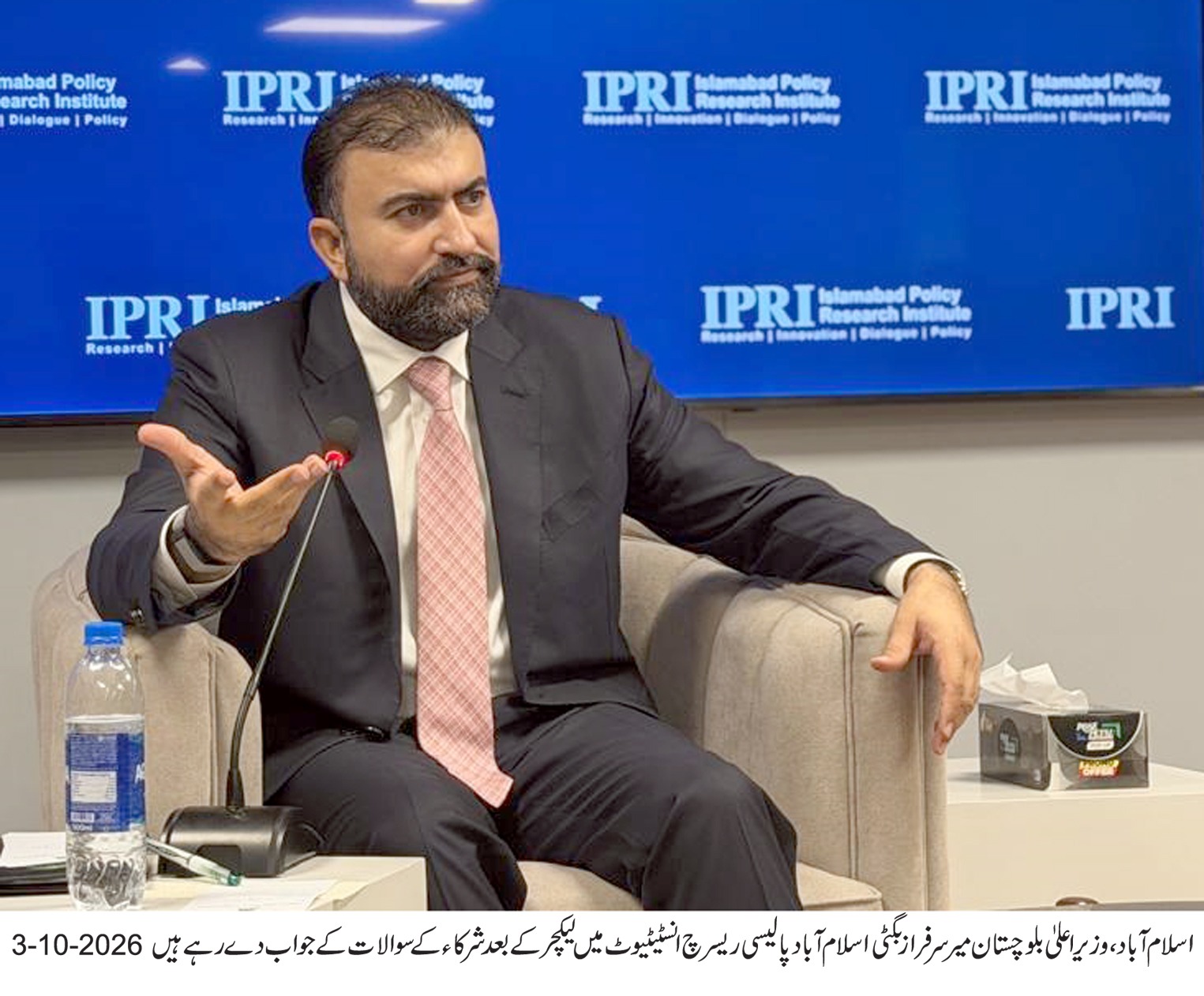
ISLAMABAD: Chief Minister Balochistan Mir Sarfraz Bugti reaffirmed the government’s commitment to political engagement while maintaining a firm stance against armed violence, stating that political issues must be resolved through democratic channels, but no dialogue will take place with those who take up arms or shed innocent blood.
Addressing a special lecture organized by the Islamabad Policy Research Institute (IPRI) on Saturday, where he was invited as the chief guest, CM Bugti emphasized that understanding Balochistan requires a comprehensive view of its history, geography, social fabric, political evolution, and ground realities rather than relying on isolated events or one-sided narratives.
He noted that lasting solutions depend on effective governance, meritocracy, political inclusion, youth engagement, economic development, and enforcing the writ of the state.
Highlighting the province’s rich heritage, Bugti referred to Mehrgarh as evidence of Balochistan’s ancient history. He explained that governance models in the region have evolved across various eras—from local tribal systems and the Khanate of Kalat to the British colonial period and modern Pakistan’s constitutional setup.
He urged researchers and the public to analyze historical events, including Balochistan’s accession to Pakistan, through verified documentary evidence rather than emotional or biased viewpoints.
The Chief Minister rejected the notion that socio-economic deprivation alone drives current regional instability. While acknowledging developmental gaps—a common challenge across global regions—he stressed that underdevelopment can never justify terrorism or the killing of innocent citizens.
To bridge the gap between the state and the youth, Bugti outlined key reform initiatives undertaken by the Balochistan government. These include AI-based merit recruitments, restoring non-functional schools, enrolling out-of-school children, hiring nearly 17,000 teachers on merit, and expanding public healthcare and youth opportunities.
On security, CM Bugti stated that peace and development are interdependent. The government is focused on modern policing, intelligence-based operations, improved prosecution, and capacity building for law enforcement agencies.
Reiterating his stance on regional peace, Bugti concluded that democratic avenues remain open for anyone acting within the parameters of the Constitution, but state authority and public safety will not be compromised.