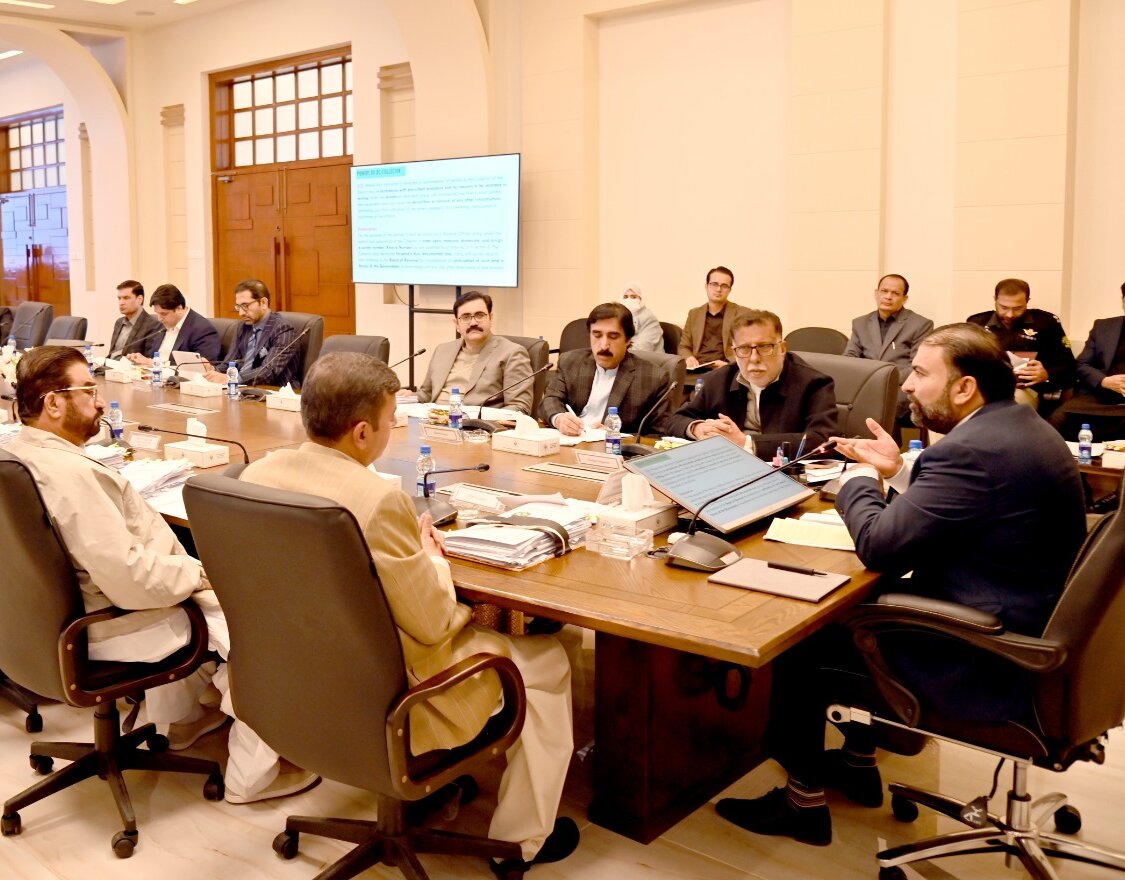
News Desk: The Balochistan Provincial Cabinet, under the leadership of Chief Minister Mir Sarfraz Bugti, has approved wide-ranging administrative, legal, and development reforms aimed at strengthening governance, security, and public service delivery across the province.
A key decision includes the approval of two new administrative divisions, Pishin and Koh-e-Suleman, to improve administrative outreach and local governance. The cabinet also decided that Ziarat will continue to remain administratively linked with Loralai district, while a new Municipal Committee, Karbala, was approved in Pishin district to enhance municipal services.
On law and order, the cabinet finalized a structured and long-term policy framework to address the issue of missing persons. Under the approved mechanism, investigations will be carried out at designated centers under the supervision of authorized police officers, ensuring legal safeguards and allowing family members to meet detainees. The cabinet approved the Balochistan Prevention, Detention and De-radicalization Rules 2025, the Balochistan Center of Excellence on Countering Violent Extremism Rules 2025, and amendments to the Witness Protection law to strengthen protection for complainants and witnesses in terrorism-related cases.
In a move to promote transparency and merit, the cabinet expressed satisfaction over online, merit-based recruitment in the Finance Department and decided to gradually digitize recruitment processes across all provincial departments. The cabinet also approved the closure of the Religious Affairs Department, with its employees to be adjusted in other government departments.
Major education reforms were also approved, including declaring the Higher Technical Education Department an essential service, verifying academic credentials of contract teachers across Balochistan, and initiating action against fake degree holders. Degree verification will begin from Naseerabad and Dera Bugti. The cabinet also agreed to adopt the national curriculum from the academic year 2026–27, launch the Chief Minister Academic Excellence Program for teacher support, and recruit ad hoc teachers for Mathematics, Science, and English.
Additionally, the cabinet banned forced labor for children under 16 and formed a committee to review proposals for establishing a food street in central Quetta.