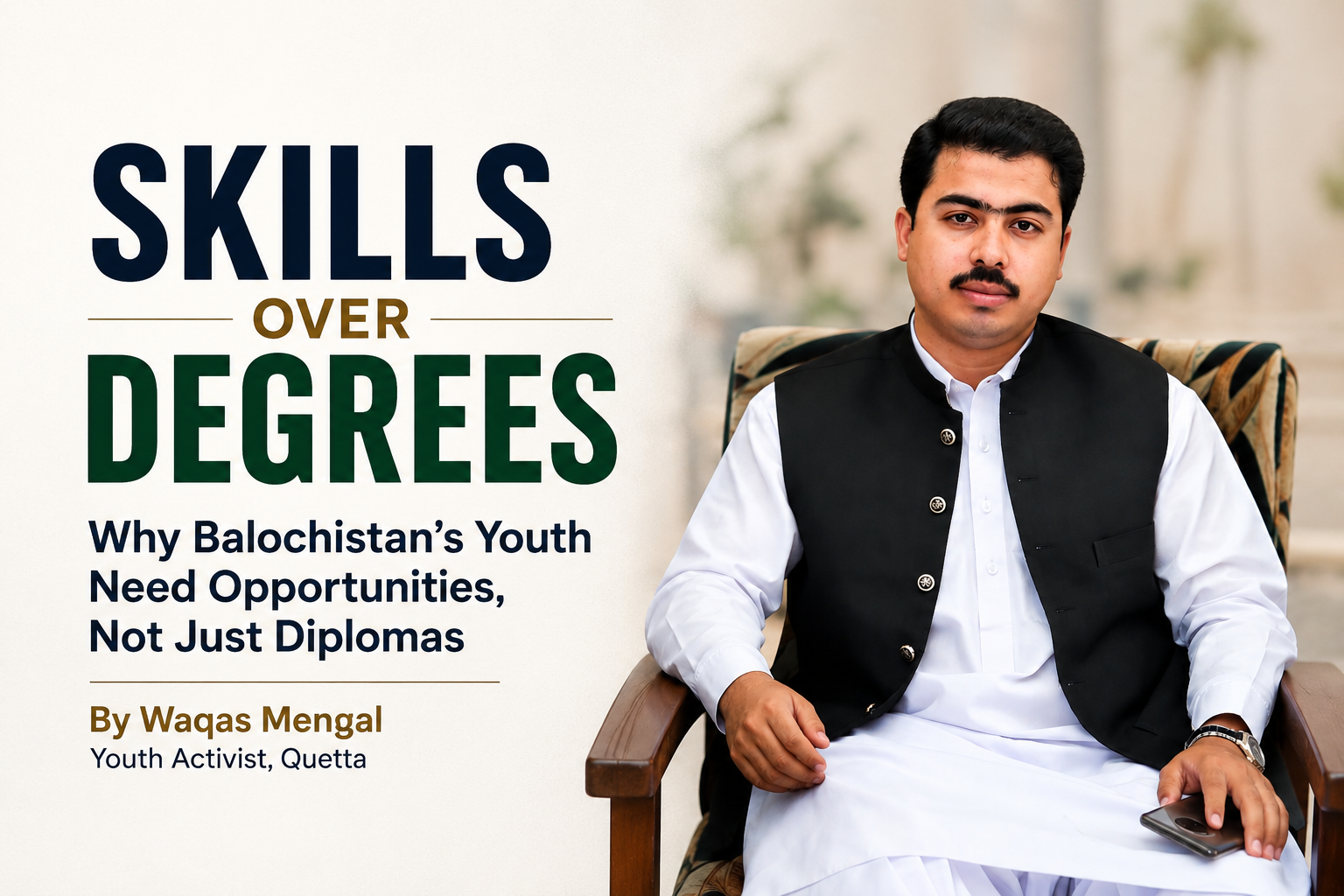
By Waqas Mengal
Balochistan is home to one of the youngest populations in Pakistan, with more than 65% of its people falling within the youth category. This should be a source of hope and strength for the province. Instead, for many young people, it has become a source of frustration as they struggle to find meaningful employment after years of education.
Across Balochistan—from Quetta to the most remote districts—thousands of young graduates are facing an uncertain future. Despite earning degrees, many find themselves unemployed, with limited opportunities to apply their knowledge or build careers. Economic challenges, security concerns, and a lack of private-sector growth have further reduced job prospects, leaving many young people feeling discouraged.
The truth is that the government alone cannot provide jobs for every graduate. While education remains important, our system continues to place too much emphasis on degrees and too little on practical skills. Every year, universities produce thousands of graduates, yet many leave campus without the tools needed to compete in today’s job market.
The world has changed. Employers are increasingly looking for people who can solve problems, use technology, create businesses, and adapt to new challenges. Skills such as digital marketing, graphic design, software development, freelancing, technical trades, entrepreneurship, and communication are opening doors for young people around the globe. Unfortunately, many students in Balochistan have little access to such opportunities.
There is wisdom in the saying that a skill can feed a person for life. A young person who possesses a valuable skill is not limited by geography or local job shortages. With the right training and internet access, they can work remotely, start a business, or provide services to clients anywhere in the world.
However, skills cannot be developed through theory alone. Young people need hands-on training, mentorship, internships, apprenticeships, and exposure to real-world challenges. They need institutions that prepare them for life beyond the classroom, not just examinations and certificates.
This is a responsibility that must be shared. The government must invest in vocational and technical education, educational institutions must align their programs with market needs, the private sector must create opportunities for training and employment, and young people themselves must be willing to learn new skills and explore emerging career paths.
Balochistan’s youth are not a burden—they are the province’s greatest asset. But potential alone is not enough. Without investment in skills, innovation, and opportunity, much of that potential will remain untapped.
The future of Balochistan will not be shaped by degrees hanging on walls. It will be shaped by young people who have the skills, confidence, and opportunities to build better lives for themselves and contribute to the development of their communities.