By Haseeb Khan Kakar
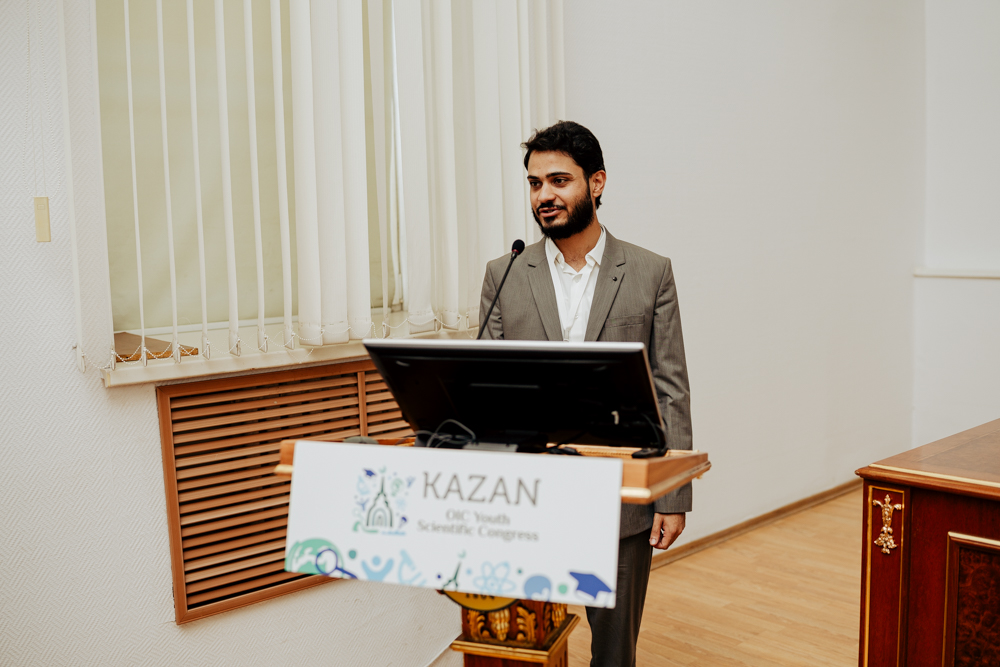
Representing Pakistan at the IV OIC Youth Scientific Congress in Kazan, Russia, was a significant milestone in my academic and research journey. For me, the experience was not only an opportunity to present my work on artificial intelligence but also a chance to bring questions about technology, accountability and governance from Balochistan to an international platform.
Held from September 30 to October 3, 2026, the congress brought together young researchers and scientists from Russia and countries of the Organisation of Islamic Cooperation (OIC). I was selected from among 2,500 applicants under the Modern International Relations and International Law track, becoming the first youth from Balochistan to be selected for the congress.
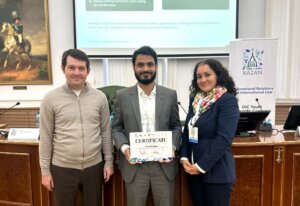
As a News Research Assistant at Quetta Voice and an alumnus of the Institute of Management Sciences at the University of Balochistan, I have remained interested in the intersection of technology, public policy and international affairs. Participating in the congress allowed me to explore these interests in an international academic setting and exchange ideas with researchers working on contemporary challenges.
My research paper, titled “Preserving Accountability in Multi-Vendor Artificial Intelligence Systems: A Framework for Multilateral Governance Cooperation,” focused on a question that is becoming increasingly important as artificial intelligence expands across industries and national borders: who is responsible when an AI system causes harm?
Modern AI systems often depend on technologies developed by several companies operating in different countries. When something goes wrong, identifying the responsible party can become difficult because the system’s design, development, procurement and deployment may involve multiple stakeholders.
I describe this challenge as “accountability diffusion.” My research proposes a framework for addressing it through three principles: traceability across decision-making processes, transparency in procurement and multilateral cooperation among states.
The central argument is that technological progress must be accompanied by clear mechanisms of responsibility. AI governance cannot remain limited to the capabilities of technology alone; it must also consider legal accountability, institutional capacity and international cooperation, particularly in countries with limited regulatory resources.
Presenting my research in Kazan was an important opportunity to discuss these questions with an international audience. The jury showed interest in the paper and asked questions following my presentation. My abstract was also accepted for presentation and publication.
One idea continues to capture the purpose of my research: “When AI causes harm, nobody is answerable because nobody is identifiable.”
I believe effective governance must ensure that responsibility does not disappear within complex technological systems. International cooperation is particularly important because AI development and deployment frequently cross national boundaries, while laws and regulatory institutions often operate within them.
My visit to Kazan was also part of a broader journey of international engagement. In 2024, I was selected as one of 10 global winners of the NATO Youth Summit Challenge from more than 16,000 applicants worldwide. My proposal addressed the governance of artificial intelligence in armed conflict, earning me a fully funded place at the NATO Youth Summit in the United States.
These experiences have strengthened my interest in responsible AI, international relations, climate justice and human rights. They have also reinforced my belief that young researchers from underrepresented regions can contribute meaningfully to global policy discussions when given opportunities to present their ideas.
Coming from Quetta, I see international academic platforms as more than personal achievements. They create opportunities to highlight perspectives from regions that are often underrepresented in global debates on science, technology and governance.
My participation in the OIC Youth Scientific Congress has encouraged me to continue researching how emerging technologies can be governed in ways that protect people, strengthen institutions and promote international cooperation.
For me, the journey from Quetta to Kazan was ultimately about taking a question beyond geographical boundaries: as artificial intelligence becomes more powerful and widespread, how can we ensure that someone remains accountable when things go wrong?