Syed Muhammad Yaseen
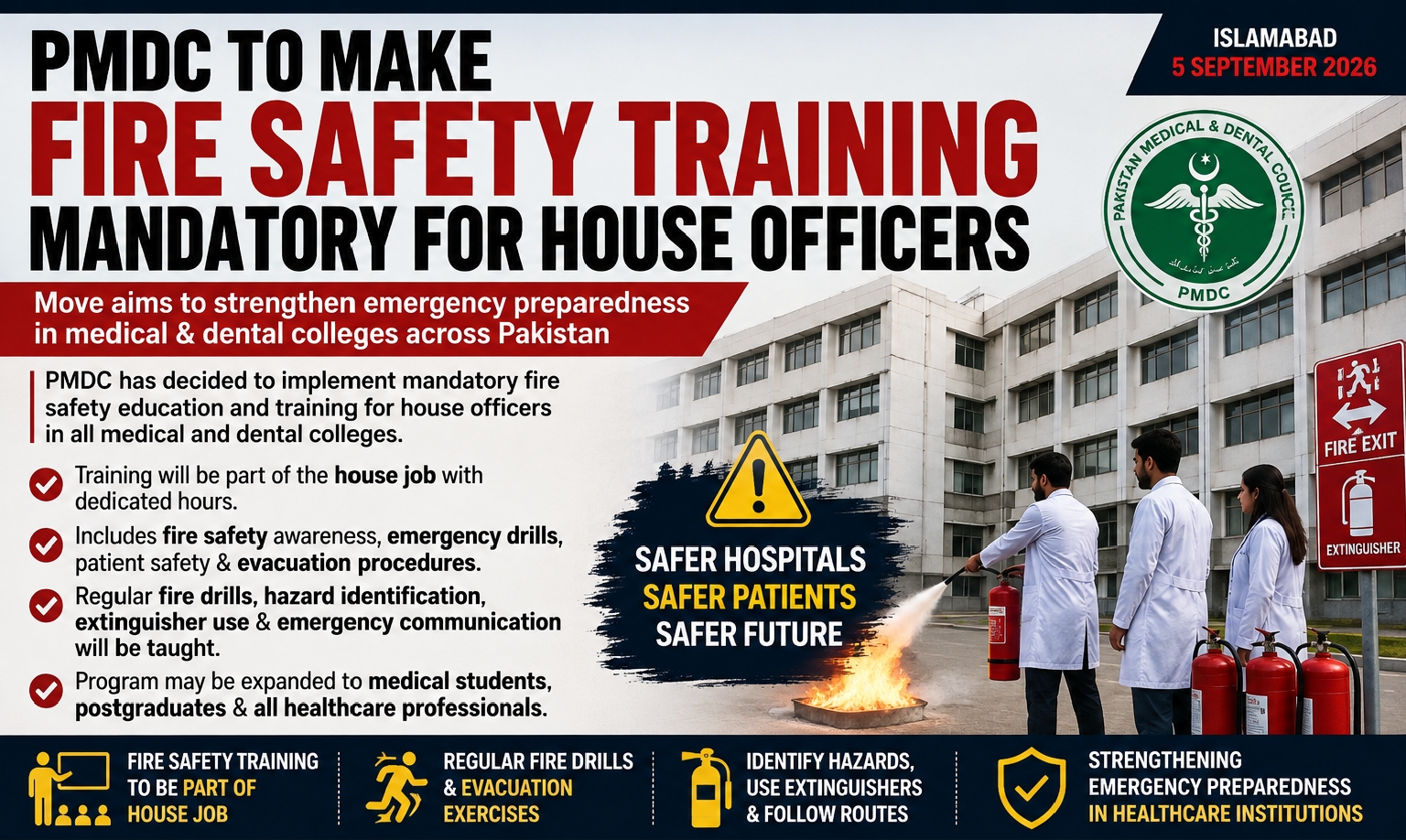
ISLAMABAD: The Pakistan Medical & Dental Council (PMDC) has decided to introduce mandatory fire safety education and training for house officers in medical and dental colleges across Pakistan.
The initiative is aimed at improving fire emergency preparedness in hospitals and medical institutions and ensuring that doctors, patients, students and hospital staff are better equipped to respond during fire emergencies.
PMDC President Prof. Dr. Rizwan Taj said the proposed fire safety program would be incorporated into the house job training, with dedicated hours allocated for practical and theoretical instruction.
The training will cover fire prevention, emergency fire drills, patient safety, evacuation procedures and effective communication during emergencies.
House officers to receive practical fire safety training
Under the proposed program, house officers will be trained to identify potential fire hazards inside healthcare facilities, operate fire extinguishers and follow designated evacuation routes.
Medical colleges and teaching hospitals will also be required to conduct regular fire drills and evacuation exercises to ensure that healthcare workers can respond promptly in the event of an emergency.
Prof. Dr. Rizwan Taj stressed that hospitals deal with some of the most vulnerable members of society, including critically ill and immobile patients who may require assistance during an evacuation.
He said healthcare institutions therefore need to move beyond simply relying on emergency response teams and develop a broader culture of preparedness and prevention.
PMDC reviewing existing fire safety arrangements
The decision follows a comprehensive review of existing fire safety protocols and emergency preparedness measures in medical institutions.
According to PMDC, the review identified areas requiring improvement, with the Council now seeking to strengthen fire prevention and emergency response mechanisms across institutions under its regulatory framework.
All medical colleges and teaching hospitals will be expected to maintain effective fire safety arrangements and emergency preparedness systems for the protection of patients, medical students, house officers, doctors and other staff.
Fire safety training may be expanded to medical students
Prof. Dr. Rizwan Taj also expressed interest in extending the initiative to medical students, postgraduate trainees and eventually other healthcare professionals.
He said fire safety should be considered an essential skill for healthcare workers, particularly because hospitals require coordinated action when emergencies occur.
The PMDC aims to establish safer learning and working environments by introducing protocols that emphasize emergency preparedness, fire prevention and rapid evacuation, rather than depending solely on emergency response after an incident occurs.
The proposed initiative could mark a significant step toward improving hospital fire safety standards and emergency preparedness in Pakistan.