Syed Ali Shah:
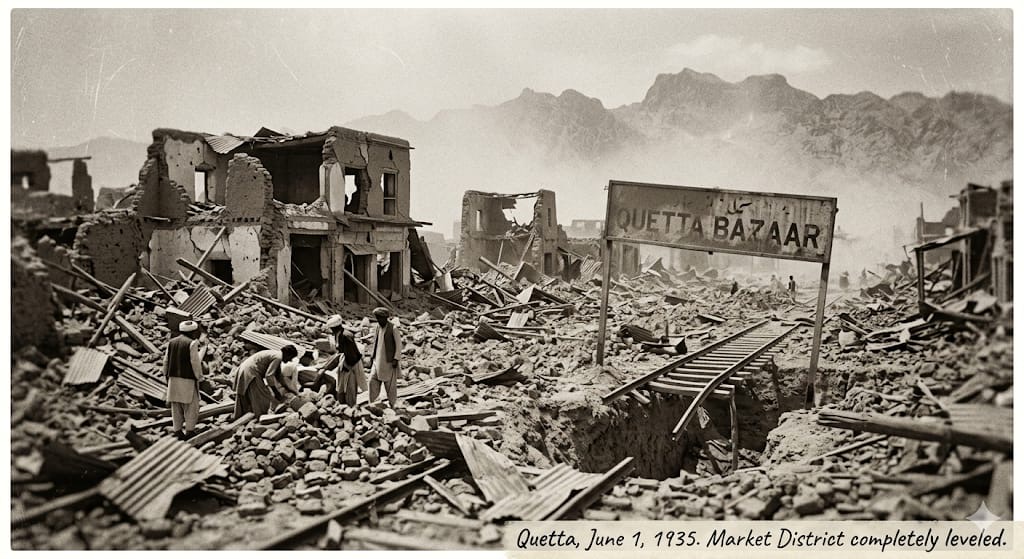
QUETTA — Today, May 31, 2026, marks exactly 91 years since the deadliest earthquake in South Asian history completely flattened Quetta. Striking in the pitch black at 3:03 AM on this very day in 1935, the massive 7.7 magnitude earthquake took the lives of an estimated 30,000 to 60,000 people in a matter of minutes, turning a bustling regional hub into a vast graveyard of rubble.
As the city pauses today to remember the souls lost nearly a century ago, a terrifying reality confronts us: the very safety laws designed to prevent this tragedy from ever happening again are being openly violated across the provincial capital.
The Colonial 30-Foot Rule: Quetta’s Forgotten Shield
Following the absolute destruction of 1935, English colonial rulers realized that Quetta sat directly on top of some of the world’s most volatile seismic fault lines, including the Chaman and Ghazaband faults. They knew standard construction was a death sentence.
In response, British administrators introduced a revolutionary, strict building code for the city in 1936 and 1937. The golden rule of this code was simple but non-negotiable:
A strict height cap of 30 feet for all structures. Buildings were limited to a maximum of two stories, and individual rooms could not exceed 30 feet in length without a reinforced, transverse support wall to absorb tectonic shocks.
This colonial building code saved countless lives. When another major earthquake struck the region in 1955, these low-rise, reinforced structures held firm, resulting in very limited casualties and proving that strict engineering laws could tame a deadly fault line.
Substandard Materials and Tall Plazas: A Disaster in the Making
Fast forward to 2026, and that defensive shield has been completely dismantled by rapid commercialization, lack of official oversight, and public indifference. Today, public memory of the deadliest earthquake has faded, and the strict rules introduced by the English rulers are being bypassed daily.
Local urban planners and engineers are sounding an urgent alarm over four critical violations currently putting Quetta at extreme risk:
Violating the 30-Foot Limit: Multistory commercial plazas and high-rise shopping centers now tower over the narrow streets of downtown Quetta, directly violating the historical safety limits.
Substandard Construction Materials: To cut costs, many modern builders are using poor-quality raw materials, weak concrete mixes, and insufficient steel rebar. In a high-magnitude quake, these materials turn to dust.
Flawed Architecture on Unstable Soil: Heavy concrete basements and massive architectural spans are being erected on Quetta’s loose, alluvial soil, which is prone to severe liquefaction (soil losing its strength and behaving like a liquid) during intense shaking.
Neglect of the National Building Code: While the Building Code of Pakistan exists on paper, actual implementation and field inspection in Quetta’s expanding housing societies remain alarmingly low.
Will History Repeat Itself?
Quetta’s population has ballooned from a few thousand in 1935 to millions today. Yet, our structural resilience has gone backward. If a 7.7 magnitude earthquake were to strike the valley today, the combination of illegal vertical construction and compromised materials could lead to a casualty count that would completely overshadow the horrors of 1935.
Remembering the tragedy should not just be about looking at old archival photos once a year. For Quetta to survive its tectonic reality, the government and civil society must immediately enforce the building codes that were bought and paid for with tens of thousands of local lives 91 years ago.