By Education Desk: If you’ve typed “UoB admission last date” into Google at 11 PM with a half-filled challan form open in another tab, you already know the problem with university admissions in Quetta: the information is scattered across five different Facebook pages, a WhatsApp group run by someone’s cousin, and a university website that hasn’t updated its homepage banner since last winter.
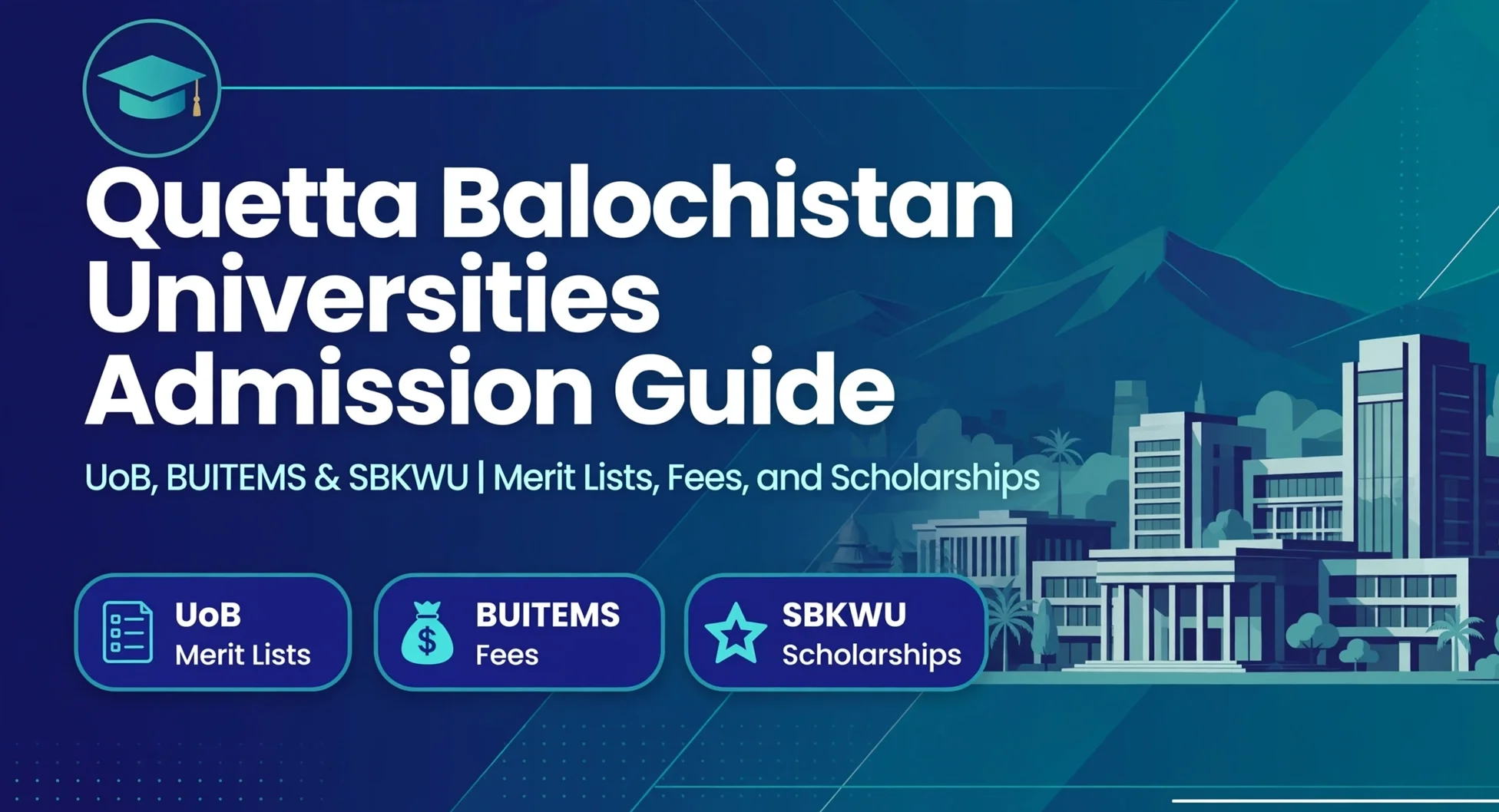
This guide puts everything in one place, how admissions actually work at the University of Balochistan (UoB), BUITEMS, and Sardar Bahadur Khan Women’s University (SBKWU), how merit lists are calculated, and which scholarships (HEC, PEEF/BEEF, and provincial) are worth your time. Bookmark it. Every admission cycle looks almost identical, so the process below will stay useful whether you’re reading this in July or reading it again next January.
Why Quetta’s Admission Season Feels So Confusing
Unlike Lahore or Karachi, where private universities dominate search results and admission consultants exist on every corner, Balochistan’s higher education landscape runs almost entirely on three public-sector institutions. That’s actually good news, fewer options means less decision fatigue, but it also means each university’s own portal is your only reliable source, and those portals aren’t always built with students in mind.
Here’s the fix: know the pattern. Every public university in Quetta follows roughly the same admission skeleton, announcement, online form, entry test (where applicable), first merit list, second and sometimes third merit list, and finally document verification. Once you understand this skeleton, you stop refreshing Facebook every hour and start checking the right page at the right time.
University of Balochistan (UoB) Admissions: What You Need to Know
UoB is the oldest and largest general university in the province, running six faculties, over fifty departments, and campuses beyond the main Sariab Road site, including sub-campuses in Turbat, Loralai, Khuzdar, Mastung, Pishin, Kharan, and Killa Saifullah.
How the seats are divided. UoB reserves the bulk of its seats for Balochistan domicile holders, but the split within that isn’t even across districts. Roughly a tenth of open-merit seats go to Balochistan-wide competition, a slightly larger share is set aside specifically for Quetta district applicants, and the majority, around three-quarters, is reserved for applicants from districts other than Quetta. On top of that, a small number of seats in each program go to children of non-local government employees serving in Balochistan, capped at a handful per department.
Programs and duration. Most undergraduate programs are 4-year BS (Hons) degrees, while professional programs like Pharm-D and DPT run for 5 years. Admission also opens for Master’s, MPhil, and PhD programs each session, alongside professional colleges like the University Law College.
How to apply. Applications go through UoB’s own online admission portal, not a third-party site. After you fill the form, you’ll need to print it, attach two sets of attested photocopies of your academic documents, your CNIC or B-Form, four recent passport-size photos, and your paid challan receipt, then physically submit the bundle to the relevant admissions office before the closing date, the Graduate Studies Office for postgraduate programs, or UGSO for undergraduate ones. An online submission alone doesn’t complete your application; the printed, signed copy matters just as much.
Fees to budget for. The application processing fee for UoB’s main campus generally runs around Rs. 1,000-4,000 depending on the program and level, with sub-campuses charging separately (commonly Rs. 3,000). Where an NTS entry test applies, for programs like Pharm-D, DPT, and BEMS, you’ll pay an additional test fee on top of the application fee. Keep your bank deposit slip; you’ll need to attach it to your physical submission.
No hostel or transport at sub-campuses. If you’re applying to the Mastung or Pishin sub-campuses specifically, know upfront that UoB does not provide transportation or hostel facilities there, a detail that catches a lot of out-of-town applicants off guard every year.
BUITEMS Admissions: Entry Test, Merit Formula, and What Actually Gets You In
The Balochistan University of Information Technology, Engineering and Management Sciences is the province’s go-to for tech, engineering, and business degrees, split across its City Campus (Management Sciences) and Takatu Campus (IT and Engineering).
The merit formula, in plain terms. BUITEMS calculates your admission score using two components: your Intermediate (FSc/ICS/A-Level or equivalent) marks account for 60% of your final score, while your performance in either the BUITEMS Entry Test or the HEC Undergraduate Studies Admission Test (USAT) makes up the remaining 40%. Both components have to individually clear the minimum threshold — a strong Intermediate percentage alone won’t save a weak test score, and vice versa.
Eligibility baseline. You’ll generally need at least 50% marks in your Intermediate exam (Pre-Engineering, Pre-Medical, ICS, or equivalent), along with meeting whatever additional HEC-mandated requirement applies to your specific program.
Seat distribution matters more than people realize. Open-merit seats at BUITEMS are reserved for Balochistan domicile holders, but a defined quota exists for students from other provinces, historically a handful of seats each for applicants from other regions of Pakistan. If you’re applying from outside Balochistan, check the current year’s quota breakdown before assuming you’re competing on the general list.
Timeline pattern. Admissions typically open in June or July for the Fall semester, with the application window commonly closing by late August, though exact dates shift slightly every year, so always confirm against the current announcement rather than a previous year’s date. Students who haven’t received their HSSC result yet can usually still apply provisionally, provided they later submit their Detailed Marks Certificate before the entry test.
Merit lists. BUITEMS releases its results in waves, first, second, and sometimes third merit lists, for both undergraduate and postgraduate programs. You’ll need your CMS ID (assigned during application, not your NTS roll number) to check where you stand on each list.
Sardar Bahadur Khan Women’s University (SBKWU): Admissions and Merit Criteria
SBKWU holds a distinct place as Balochistan’s, and Pakistan’s third, dedicated women’s university, established in 2004 on a 40-acre campus on Brewery Road, Quetta. It offers Bachelor’s, Master’s, MPhil, and PhD programs across Arts, Sciences, Social Sciences, and Management disciplines exclusively for female students.
Merit formula. SBKWU’s BS admission score is generally built from three parts: Intermediate or A-Level marks contribute 40%, the university’s own entry test contributes 50%, and an interview or additional assessment (where applicable) makes up the remaining 10%. This is a noticeably different weighting than BUITEMS, so a strong entry-test performance matters more here than at some other institutions.
Entry test format. The test is computer-based and evaluates core subject knowledge alongside English proficiency. A minimum score around 50% is typically expected to remain eligible for BS programs.
Scholarships tied to SBKWU specifically. Beyond the province-wide schemes listed below, SBKWU runs its own Institutional Scholarship Awarding Committee, which periodically reviews applications for opportunities like the Scotland Pakistan Scholarships for Young Women and Girls, worth checking directly with the university’s registrar office each session, since these aren’t always advertised as widely as the bigger national schemes.
Programs worth noting. In recent sessions, SBKWU has expanded into more market-facing degrees, BS Data Science, BS Software Engineering, BBA, Banking & Finance, and Pharm-D, alongside its traditional Arts and Sciences base, so it’s no longer purely a liberal-arts option for female students in Balochistan.
How Merit Lists Actually Work (And Why Your Name Might Not Appear on the First One)
This is the part that causes the most anxiety every single admission season, so let’s break it down clearly.
A merit list is not a rejection. If your name isn’t on the first merit list, it usually just means your calculated score fell below the current cutoff for that specific program, cutoffs shift up or down every year depending on how many people applied and how strong the applicant pool was. Universities release second and sometimes third merit lists specifically to fill seats vacated by students who got in elsewhere or didn’t confirm their spot in time.
What determines your score. Across UoB, BUITEMS, and SBKWU, your final merit score is a weighted combination of your Intermediate (or equivalent) academic result and an entry test, the exact weighting differs by university, which is exactly why we broke down each formula separately above rather than giving you one generic number.
What to do if you don’t clear the first list.
- Don’t withdraw your documents, wait for the next merit list before assuming you’re out.
- Check if a different, less competitive program within the same university has open seats, cross-program migration is often possible before final admission closes.
- If you believe there’s a calculation error, most universities allow a formal written objection with your original documents, but you typically need to act within days, not weeks.
- Keep an eye on sub-campuses (UoB’s Turbat, Khuzdar, Mastung, and Pishin campuses, for example), merit cutoffs there are frequently lower than the main Quetta campus for the identical program.
Document verification is not a formality. Every merit list is provisional until you physically verify your original documents. Bring your original Matric and Intermediate certificates, detailed marksheets, CNIC/B-Form, domicile certificate, and photographs, a missing original at this stage can cost you the seat even after your name appears on the list.
Scholarships: HEC, PEEF/BEEF, and Provincial Options for Balochistan Students
Getting admitted is half the fight; paying for four years is the other half. Here’s what’s actually available to students in Balochistan.
PEEF / BEEF Scholarships for Balochistan Students
The Balochistan Education Endowment Fund (BEEF), working in partnership with the Punjab Education Endowment Fund (PEEF), runs one of the most consistent need-based scholarship schemes available to Balochistan-domicile students.
Core eligibility:
- Balochistan domicile required
- Passed Matric, Intermediate, or Graduation from a government institution in Balochistan with at least 60% marks (or a minimum 2.5 CGPA for BS/BA/BSc-level applicants)
- Enrolled as a full-time student in a registered institution
- Parents’ combined monthly income below a set threshold (commonly cited around Rs. 60,000, though this figure is revised periodically, always check the current notification)
- Not already receiving another scholarship or stipend
Children of Grade 1-4 government employees are typically exempted from the income cap, and special consideration is given to children of civilians martyred in terrorist attacks.
Special program worth knowing about: the Shaheed Benazir Bhutto Matric District Toppers Scholarship, a fully-funded scheme under BEEF that automatically identifies the top-scoring boys and girls (five each) in every district based on Matric board results, no lengthy application needed, since board data is transferred directly to BEEF, which then publishes a provisional merit list. If you’re a district topper and don’t see your name, you can file a manual objection with your official result letter.
Where to apply: Application forms are available through the BEEF office (Chaman Housing Scheme, Airport Road, Quetta, near the HEC regional office) and downloadable from the official PEEF/BEEF portals. Deadlines shift every session, treat any date you find online as provisional until you confirm it against the current year’s notification.
HEC Need-Based and Merit Scholarships
The Higher Education Commission runs several national schemes that Balochistan students are eligible for alongside provincial ones, including need-based financial assistance programs, the Ehsaas Undergraduate Scholarship Program, and merit scholarships tied to USAT performance. These are typically administered through your university’s financial aid or scholarship office rather than applied for directly on HEC’s website, so once you’re admitted, your first stop should be your university’s scholarship desk, not a Google search.
University-Specific and Institutional Scholarships
All three universities covered above run their own internal scholarship committees on top of provincial and national schemes, covering everything from need-based tuition waivers to specific donor-funded programs (like SBKWU’s women-focused international partnerships). These rarely get the same visibility as PEEF or HEC schemes simply because they’re announced through campus notice boards and internal circulars rather than national media, so it pays to check directly with your registrar’s office once you’re enrolled.
A Practical Scholarship Checklist
- Confirm your domicile and CNIC/B-Form are ready, nearly every scholarship in Balochistan requires proof of provincial domicile
- Calculate your family’s combined monthly income against the current threshold before assuming you’re ineligible
- Apply to more than one scheme simultaneously where rules allow, PEEF/BEEF and university-specific scholarships aren’t always mutually exclusive at the application stage, even if you can only hold one at a time
- Keep digital copies of every marksheet and certificate, most scholarship deadlines are tight, and re-requesting documents from your board takes time you won’t have
Frequently Asked Questions
When do UoB, BUITEMS, and SBKWU admissions typically open? Fall semester admissions across all three universities generally open in June or July, with deadlines commonly falling in the second half of July through late August. Spring admissions, where offered, typically open around December-January. Exact dates change every year, so treat this as a seasonal pattern rather than a fixed calendar.
Can I apply to more than one university at the same time? Yes. There’s no rule preventing you from applying to UoB, BUITEMS, and SBKWU (if eligible) in the same session. Many students do exactly this to maximize their chances, since each university calculates merit differently.
Do I need to pass an entry test for every program? Not always. Entry tests are mandatory for most BS programs and professional degrees like Pharm-D and DPT, but some programs admit purely on academic merit. Check the specific program’s requirement on the university’s official prospectus before assuming.
What happens if I miss the first merit list deadline for document verification? Universities typically move to the next candidate on the waiting list if you don’t verify and confirm within the given window, usually a matter of days. Always check the exact confirmation deadline printed alongside the merit list itself, not just the list’s publish date.
Are sub-campus degrees (Turbat, Khuzdar, Mastung, Pishin) equal in value to main campus degrees? Yes, sub-campus programs are run under the same university charter and HEC recognition as the main campus. The practical differences are usually facilities (transport, hostel availability) and merit cutoffs, not the degree’s academic standing.
This guide reflects the admission structures, merit formulas, and scholarship criteria as generally applied at UoB, BUITEMS, and SBKWU. Exact dates, fee amounts, and income thresholds are revised by each institution every session, always cross-check against the current official notification on the university’s website before submitting your application or scholarship form.