By Syed Dara Shikoh Amir
For Balochistan, the conversation around Artificial Intelligence is no longer about a distant future. AI is already changing education, healthcare, agriculture, industry, finance and governance. The real question is whether Balochistan’s universities and young people will be prepared to participate in this transformation.
When Governor Balochistan and Chancellor of the province’s public-sector universities, Jaffar Khan Mandokhail, addressed the Youth and AI Summit at the United Nations Headquarters in New York, his message carried significance beyond a discussion on technology. It placed Balochistan’s youth, universities and technological ambitions within a global conversation about the future.
For a province with a predominantly young population, this is an opportunity that cannot be ignored. Balochistan’s greatest advantage may not simply be its geography or natural resources, but the potential of its young people.
AI Is Already Changing the Landscape
Artificial Intelligence is rapidly becoming part of almost every major sector. For Balochistan, this transformation could offer practical solutions to some of its most persistent challenges.
AI and Data Science can support better healthcare decisions, improve agricultural monitoring, assist in analysing geological information, strengthen public services and contribute to more efficient use of resources.
But technology cannot transform a society on its own. It needs people who understand it, institutions that can develop it and universities capable of turning knowledge into practical solutions.
This makes higher education central to Balochistan’s digital future.
BUITEMS and the Beginning of a Shift
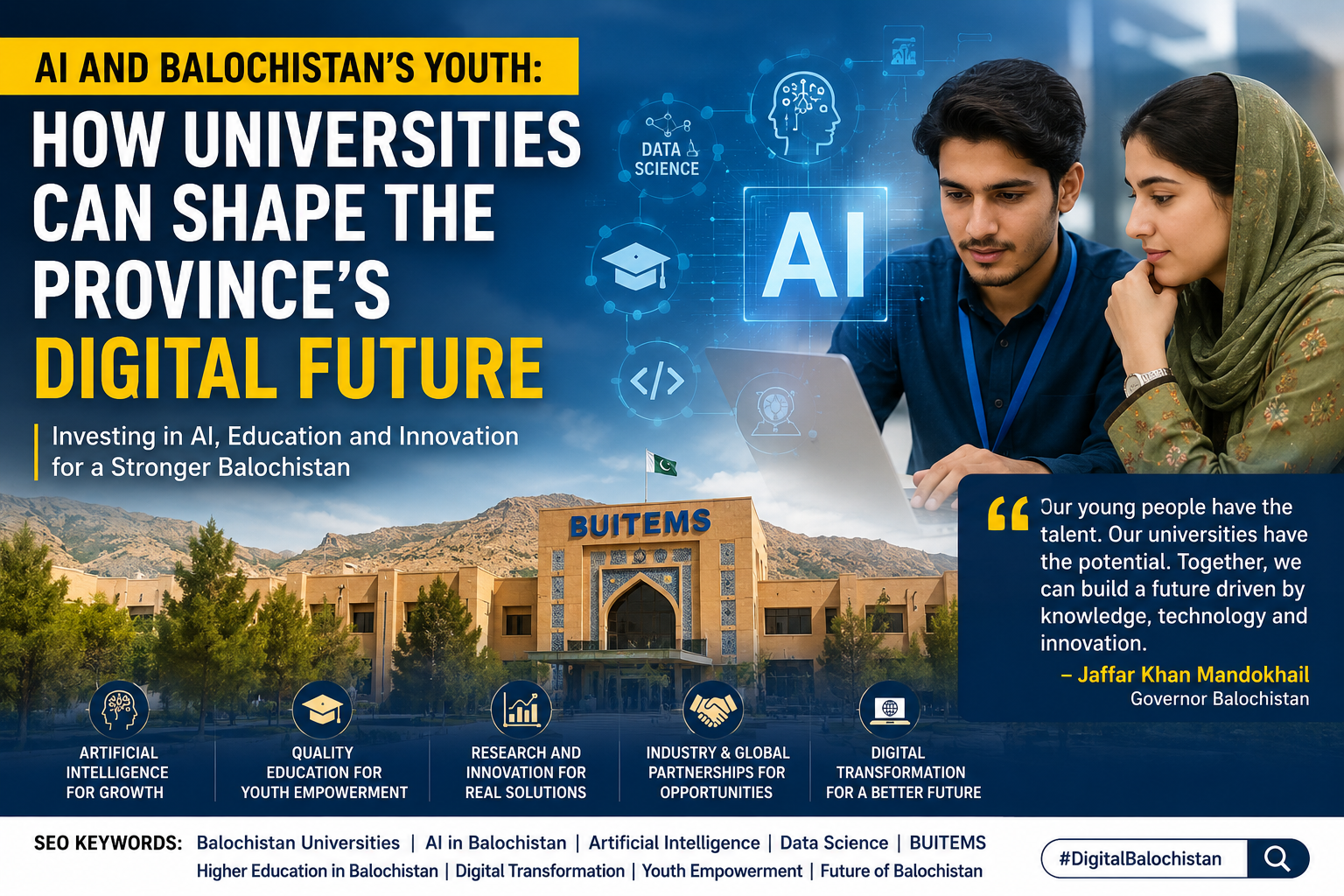
Balochistan University of Information Technology, Engineering and Management Sciences (BUITEMS) has introduced programmes in Artificial Intelligence and Data Science while incorporating emerging technologies and data-focused learning into different academic disciplines.
This development is significant because AI should not be treated as a field restricted to computer science.
A mining engineer who understands data analytics can better interpret geological information. An agricultural researcher can use AI to monitor crops. A healthcare professional can use data to identify trends and improve decision-making.
The real potential of Artificial Intelligence lies in its ability to strengthen almost every profession.
For Balochistan, the goal should therefore be to develop an academic environment where technology is used not simply to teach students, but to address real problems.
From Degree-Holders to Problem-Solvers
For decades, universities have largely focused on producing graduates for established professions. But the pace of technological change is making that approach increasingly inadequate.
Students entering the workforce today may encounter technologies, processes and even job roles that did not exist when they began their studies.
Universities must therefore teach more than professional knowledge. They must teach students how to learn, adapt, think critically, innovate and solve problems.
This is where AI and Data Science can become powerful tools.
The objective should not simply be to produce graduates who know how to operate new technologies. It should be to develop young people capable of looking at a problem in their community and asking how technology, research and innovation can help solve it.
Balochistan’s Challenges Can Become Research Opportunities
The province itself provides a vast field for meaningful research.
Water scarcity, mineral resources, agriculture, renewable energy, healthcare access, environmental change, urban planning and education all offer opportunities for technology-driven research.
Perhaps universities should therefore ask a different question.
Instead of asking only, “What degree programmes should we offer?”, they should also ask, “What problems can we help solve?”
That change in thinking could redefine higher education in Balochistan.
Students of Artificial Intelligence and Data Science could work alongside engineers, doctors, economists, environmental scientists and social researchers. Universities could collaborate with government departments, industries, businesses and local communities.
Such partnerships would allow academic knowledge to move beyond classrooms and become practical solutions for society.
Digital Transformation Requires More Than Technology
The call for digital transformation across Balochistan’s public-sector universities is important, but introducing AI programmes is only the beginning.
A genuinely AI-ready university requires trained faculty, modern laboratories, computing facilities, updated curricula, research funding and stronger links with industry and international institutions.
The same applies to the idea of a paperless university.
Digitalisation should not simply mean replacing paper files with computer screens. It should improve teaching, research, administration, information management and decision-making.
The ultimate goal should be universities that are digitally enabled, research-driven and connected to national and international networks.
Connecting Balochistan’s Youth to the World
The Governor’s participation in the United Nations Youth and AI Summit also highlights the importance of international engagement.
Around the world, universities are working to develop AI skills, expand research, create technology partnerships and prepare young people for the digital economy.
Balochistan’s youth should have access to those opportunities.
International research collaborations, scholarships, technology partnerships, entrepreneurship programmes and knowledge networks can give students exposure beyond traditional academic boundaries.
At the same time, Balochistan’s universities should aim to become contributors to global research rather than remaining only consumers of knowledge developed elsewhere.
Turning Vision into a Long-Term Strategy
The real challenge begins after the speeches and international headlines.
Balochistan now needs a sustained strategy for AI education, Data Science, research, innovation and digital transformation.
Its universities should work more closely with government, industry and communities. Students should be given opportunities to work on real-world problems, develop startups and turn research ideas into practical projects.
The progress already visible at BUITEMS demonstrates that this direction is achievable and can contribute to a broader movement towards technology-driven higher education across the province.
Balochistan’s Greatest Resource
Balochistan is frequently discussed in terms of its natural resources and vast geography. But its greatest long-term resource may ultimately be its people.
The province has a young population and talented students. What is needed is an education system capable of turning that potential into opportunity.
If Balochistan can connect its universities, youth, Artificial Intelligence, Data Science, research and innovation, its young people will not merely be prepared for the future.
The message from New York should therefore be seen as an opportunity to think beyond individual programmes and towards a broader vision for higher education in Balochistan.
The province’s next frontier may not be found only beneath its soil.
It may be found in its classrooms, laboratories, research centres and, above all, in the minds of its young people.