
Health Desk
Pakistan has officially strengthened the professional role of optometrists with the introduction of a new Scope of Practice for Optometrists, approved by the Allied Health Professionals Council (AHPC) under the Ministry of National Health Services, Regulations and Coordination.
The new framework formally defines the responsibilities, competencies, and legal boundaries for licensed optometrists, bringing optometry regulation in Pakistan closer to international standards and reinforcing the profession’s importance in the national healthcare system.
Optometry Recognized as a Category A Healthcare Profession
Under the AHPC framework, optometry has been classified as a Category Type A profession, recognizing optometrists as autonomous primary eye care providers in Pakistan. This classification confirms that optometrists are independent healthcare professionals capable of delivering diagnostic, preventive, therapeutic, and rehabilitative eye care services.
The recognition distinguishes optometrists from paramedical support roles and empowers them with greater clinical decision-making authority in eye and vision care.
Here is a letter of recognition of optometrists;
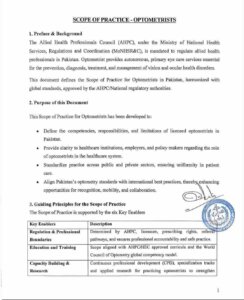
The definition of optometry in the document follows international standards established by the World Council of Optometry and the World Health Organization Eye Care Competency Framework. According to these guidelines, optometrists are trained healthcare practitioners who provide comprehensive eye examinations, vision correction, early disease detection, and rehabilitation of visual system disorders.
Purpose of the New Optometry Practice Framework
The newly approved AHPC Scope of Practice for Optometrists in Pakistan aims to:
Clearly define the competencies and professional responsibilities of licensed optometrists.
Provide guidance to hospitals, clinics, and healthcare institutions regarding the role of optometrists in patient care.
Standardize optometry practice across public and private healthcare sectors in Pakistan.
Align Pakistan’s optometry profession with global best practices and international standards.
Enhance professional recognition, collaboration, and workforce mobility in the field of vision care.
Key Principles Guiding Optometry Practice
The framework outlines several core pillars that will guide professional optometry practice in Pakistan, including:
Regulation and Professional Boundaries: Licensure and professional accountability overseen by AHPC.
Education and Training: Alignment with nationally approved academic programs and international competency standards.
Capacity Building and Research: Continuous professional development (CPD) and research initiatives to advance the profession.
Ethics and Professionalism: Commitment to patient-centered, evidence-based clinical care.
Collaboration and Referral Systems: Integration with broader healthcare services through structured referral pathways.
Individual Scope of Practice: Clinical responsibilities based on training, expertise, and ongoing professional development.
Authorized Clinical Responsibilities of Optometrists
According to the new policy, associate optometrists in Pakistan are authorized to perform a wide range of primary eye care services, including:
- Comprehensive eye and vision examinations, including refraction and binocular vision assessment.
- Diagnosis of accommodative and functional vision problems.
- Low vision assessment and rehabilitation.
- Prescription and dispensing of spectacles, prisms, filters, and low vision devices.
- Primary screening for eye diseases such as diabetic retinopathy, glaucoma, and cataracts.
- Community eye health programs, including school vision screening and blindness prevention initiatives.
- Patient education on ocular hygiene, preventive eye care, and visual ergonomics.
Diagnostic Equipment Authorized for Optometrists
The scope also grants optometrists authority to operate and interpret results from several essential diagnostic instruments used in modern vision care, including:
- Autorefractors, phoropters, and lensometers.
- Non-contact tonometers for intraocular pressure measurement
- Slit-lamp biomicroscopes for anterior segment examination
- Direct ophthalmoscopes and non-mydriatic fundus cameras
- Visual acuity, contrast sensitivity, and color vision testing systems
Defined Limitations in Optometry Practice
Despite expanded responsibilities, the document clearly states that associate optometrists are not authorized to perform intraocular or laser eye surgery. Additionally, they cannot independently prescribe therapeutic pharmaceutical agents, ensuring clear boundaries between optometry and ophthalmology.
Practice Settings and Referral System
The policy allows optometrists to practice independently in community clinics, hospitals, and optical practices across Pakistan. However, cases involving complex ocular disease, neurological vision disorders, or systemic conditions must be referred to specialized optometrists or ophthalmologists.
Strengthening Pakistan’s Eye Care System
Healthcare experts believe the implementation of the AHPC optometry scope of practice will significantly strengthen primary eye care services in Pakistan. By formally recognizing optometrists as frontline eye care providers, the initiative aims to improve access to vision services, enhance early disease detection, and support national efforts to reduce preventable blindness.
The move is expected to play a key role in advancing eye health, vision care accessibility, and professional development for optometrists across Pakistan.